
The Prison Empire of Ukraine. How prisons add extra years behind bars to prisoners’ sentences
- Тарас Зозулінський
IX.
For a new prison term
At the end of August 2020, the prisoner Serhiy lodged a complaint with the Voznesensk сity district court in the Mykolaiv region. He complained about the actions of the administration of Voznesensk Correctional Colony No. 72.
The court returned Serhiy’s complaint, justifying its decision that he should have filed a claim rather than a complaint.
Meanwhile, at the correctional colony, they decided to teach the prisoner a lesson. After all, it is unheard of for convicts to expose the ‘kings and gods of the prisons’.
They began to pin Article 391 of the Criminal Code on Serhiy – wilful disobedience of the lawful demands of the prison administration. He was thrown into the disciplinary isolation unit, where they filmed him refusing to clean his cell.
For this, Serhiy received a new sentence – one year.
The Voznesensk colony doesn’t stand on ceremony with troublemakers. Twelve of its prisoners have received new sentences for disobeying the administration’s orders since 2021.
Roman, from the Rivne region, had been sentenced to ten years for murder. He would have had 7 months and 16 days left to serve. Roman must have made plans for the future. Find a job, make a family. The prospect of freedom was inspiring. Meanwhile, at Kolomyia Correctional Colony No. 41, a very different future was being planned for the prisoner, and arrangements were being made for his new sentence.
As a result, Roman was given an additional year’s imprisonment – just as in Serhiy’s case – for refusing to clean his cell.
The prison staff wanted to film the whole process of him cleaning his cell - he told the judge. As there are a large number of similar videos from various prisons on the internet, he refused. He didn’t want to be humiliated in that way.
The judge at the Kolomyia city district court in the Carpathian region listened to him, but still added a further prison term.
There have already been 18 men ‘trained’ in this way by the Kolomyia prison complex since 2021.
Article 391-a has become a powerful weapon that allows authorities to exert complete control over prisoners in penal colonies, breaking their will. Prisoners are handed down between 1 and 3 years’ additional punishment for disciplinary offences.
In 2026, prisoners were handed down additional years behind bars for refusing to clean, failing to keep their hands behind their backs, not wearing their identification badge, failing to fall into line during inspections, or refusing to occupy the sleeping place allocated by the administration.
Such disciplinary offences also formed the basis of sentences in the years 2021–2025.
Human rights defender Andriy Didenko, from the Kharkiv Human Rights Group, has been highlighting this issue for more than fifteen years, insisting on the need to abolish criminal punishment for such disciplinary offences committed by prisoners.
- This model of criminal punishment effectively amounts to holding a person accountable a second time for the very same offence. In legal terms, this is known as ‘disciplinary preclusive effect ’. In other words, a person is held disciplinarily liable for ‘disobeying’ the institution’s administration: for inappropriate behaviour, failing to follow the daily routine, not getting up at the appointed time, or not making their bed. As an example, they are sent to a disciplinary isolation cell for 15 days.
Then they are held criminally liable. The sole element of the crime, as far as the court is concerned, is that the person had previously been placed in a cell-type facility (CTF).
This is sufficient for the court. This is because the wording of Article 391 of the Criminal Code of Ukraine is the offense is considered proven if a person has received a disciplinary sanction in the form of placement in a PKT.
The Kharkiv Human Rights Group has repeatedly demanded that this article be repealed without any alternatives.
The existence of Article 391 in no way contributes to the purpose of criminal punishment, which should be resocialization. That is, the creation of conditions and measures designed to change a person’s mindset. Basically a person who has committed a crime and harbors a negative attitude toward society should undergo a transformation and become law-abiding and conscientious.
“So this article of the Criminal Code has absolutely no impact on resocialization; rather, it is a repressive, punitive model,” Andriy Didenko explains.
But unlike the two previous characters, Oleg was caught up by Raikivska Zone 73 while he was already on the outside. Oleg served his sentence at that prison and was released on July 10, 2024. On April 21, 2025, thanks to the efforts of Raikivska “73rd,” he was sentenced to one and a half year in prison. So Oleg didn’t get to breathe the “free” air for long, because the prison administration had other plans for him.
His insistence in court that all this happened because of strained relations with the prison administration—which systematically tried to humiliate him by forcing him to clean while being videotaped—did not help him.
The verdict was based on an incident in which Oleg refused to take his assigned sleeping spot in the ward when he was brought back from solitary confinement. And it appears that this situation was deliberately orchestrated by prison staff. After all, Oleg was ordered to take not his own bed, but another person’s bed and this bed was already taken. The lawyer’s argument—that the bed had been occupied by another person and this fact was documented during an inspection by prison staff, so Oleg was physically unable to occupy it and had slept in his own spot—did not refute the man’s guilt in the court’s view.
Thus, thanks to the efforts of the Raikivska Prison, Oleg received a new sentence and another year and a half behind bars.
This zone imposes new sentences on such people—because it takes into account the “criminal propensity of the individual.”
As in Vladimir’s case, who was also “punished” for refusing to occupy his assigned sleeping space in the ward and recived an additional one-year sentence.
It’s not customary to go easy on convicts in Zone 73. Here, people have been “broken” with extra years behind bars since time immemorial. Since 2021 13 inmates have received new sentences at the whim of the prison administration.
For example, last month after a failed appeal, a local inmate Oleksandr was sentenced to 1 year and 9 months. He did not admit guilt in court. He told the judge that he kept his cell clean, cleaning it regularly with his own supplies. He refused to clean only when prison staff were present. In other words, he cleaned it himself—but refused to do it when they were present and video recording was taking place.
Alexander’s position did not convince the judge.
Fedor also used this argument to justify his refusal to clean the cell. “They made me a scapegoat,” he protested in court. “I’m not a clown to be filmed while I’m cleaning. And then my kids would watch it on YouTube.”
Despite his assurances that he had no ties to the criminal underworld, and despite the fact that he has two young children and a seriously ill mother, Fyodor received a new sentence of one and a half years. The judge ruled that the defendant’s behavior significantly undermined the authority of prison officials in the eyes of other inmates, which severely hinders the normal operation of the correctional facility.
At the time this sentence was handed down, Fyodor had only 8 days remaining on his previous sentence.
Meanwhile, the inmate Ivan testified in court about the unlawful actions of prison staff and the physical violence he had suffered.
However, the judge took into account a letter from the Raikivska Penitentiary Zone itself, which stated that, according to the results of an investigation, no evidence of either physical or psychological pressure had been found.
It’s practically a satire—a convict complains that he’s being beaten at the prison, and the investigation is conducted by the prison itself. “Were you beaten?”—“No, come on.”
August 8, 2020, Ivan should have been released. By that point, the prison had already launched a full-scale investigation against him. So no one had any intention of releasing Ivan. The day before his release, he was taken into custody at the pretrial detention center.
The court’s initial verdict under “Article 391” was overturned on appeal. The case dragged on.
The second time, in June 2022, Ivan was sentenced to 2 years and 8 months. The appeal reduced the sentence by 6.5 months. By the time the Zhytomyr Court of Appeals issued its ruling, Ivan had already served all but two days of his sentence.
The Raikivska Colony is one of those places that continues to haunt people even after they’re released. And it doesn’t forget those who defied the administration.
Quietly being released after serving one’s sentence, reintegrating into society, and getting back on the path to rehabilitation—it's not about the Colony No. 73. Because even months, or even years, after release, convicts are “pinned” with charges of malicious insubordination and thrown back into prison.
Murad enjoyed his freedom for less than 1.5 years. In February 22, the Berdychiv City and District Court “handed down” a new sentence to him—1 year and 10 months—for disobeying the administration of the Raikivska Zone.
Murad was convinceing the judge that the administration had developed a hostile attitude toward him because he was a vagrant, belonged to a different religion, and constantly criticized them; as a result, he was subjected to disciplinary action practically all the time, placed in disciplinary isolator, and spent almost his entire sentence there.
They cleaned their cell every day, as they were living there and needed it to be clean; they even brought water in jerrycans themselves for this purpose. He insisted that he had never refused to clean, but would not allow himself to be humiliated, and immediately stated that he would not clean in the presence of prison staff. Instead, they should have left him the cleaning equipment and returned in half an hour.
However, the prison management insisted that he had to clean in their presence and that it had been video-recorded. In such cases, he refused.
Obviously, for the judges of the Berdychiv City District Court, the interests of the Raikov Correctional Colony take precedence in such cases.
Murad had to return behind bars.
It is likely that the state tries to formally resolve the situation. So Government Bill No. 15003 is currently before parliament. However, human rights activists insist that the Cabinet of Ministers’ initiative amounts to a mere formal ‘repeal’. Although Draft Law No. 15003 is presented by the Government as abolishing criminal liability under Article 391, and is supposedly a measure of ‘humanisation’, it introduces a new concept of ‘malicious disobedience’ into the Criminal Enforcement Code.
Mykhailo Romanov, an expert on penal law at the Kharkiv Human Rights Group and a candidate of legal sciences, has analysed the draft bill in detail.
He concluded that the Government is engaging in “backroom manoeuvring”, which could result in a convicted person serving their sentence in the disciplinary isolation unit (karcer) of a maximum-security prison.
“Acording to statistic the vast majority of sentences in Ukraine are for terms of between 3 and 5 years so placing convicts in the disciplinary isolation unit for ‘malicious insubordination’ for a period of one year would result in the security level of their detention being raised, and, consequently, all other restrictions on their rights by 20–30 per cent of the total duration of their sentence.”
Having analysed the data from the court register, we uncovered some disheartening facts.
Since 2021, 416 prisoners in Ukraine have been classified as ‘notorious troublemakers’ by prison authorities.
We found only one acquittal in the court of first instance.
One other prisoner was exempted from criminal liability due to the expiry of the limitation period.
So two people were spared. And 416 were convicted.
The number of convictions is as follows: January–April 2026 – 21, 2025 – 47, 2024 – 70, 2023 – 86, 2022 – 78, 2021 – 116.
As we can see, the number of convictions under Article 391 is falling, but it is worth bearing in mind that, due to the full-scale war, a number of penal colonies have ‘fallen away’ as a result of the aggressor’s temporary occupation of territories. The total number of convicts has also fallen significantly, with a large proportion having gone off to fight voluntarily.
The only chance of avoiding a new prison sentence for ‘malicious’ insubordination lies with those prisoners who, at the time the sentence was handed down, had already served their sentences for previous offences and been released.
Since 2021, 17 out of 416 convicted individuals have received suspended sentences with probation. A further two were fined. Four convicted persons were sentenced to between 1 and 6 months’ detention (as they were being held in Detention center at the time).
It is worth noting that, alongside the decrease in the number of convictions for ‘malicious disobedience’, there has also been a reduction in the number of non-custodial sentences handed down by the courts.
There were no probation orders in the first four months of 2026. And only one each in 2025 and 2024.
However, it is worth emphasising that our analysis has also shown that even the mere fact of a person’s release and being at liberty does not always mean that such a convicted person will be given a suspended sentence. This is because, in a number of cases, individuals continue to have additional sentences imposed on them for ‘malicious disobedience’ towards the prison administration and are sent back behind bars.
X.
Conveyor belts of additional sentences. Prisons that lead the way in imposing new sentences on prisoners
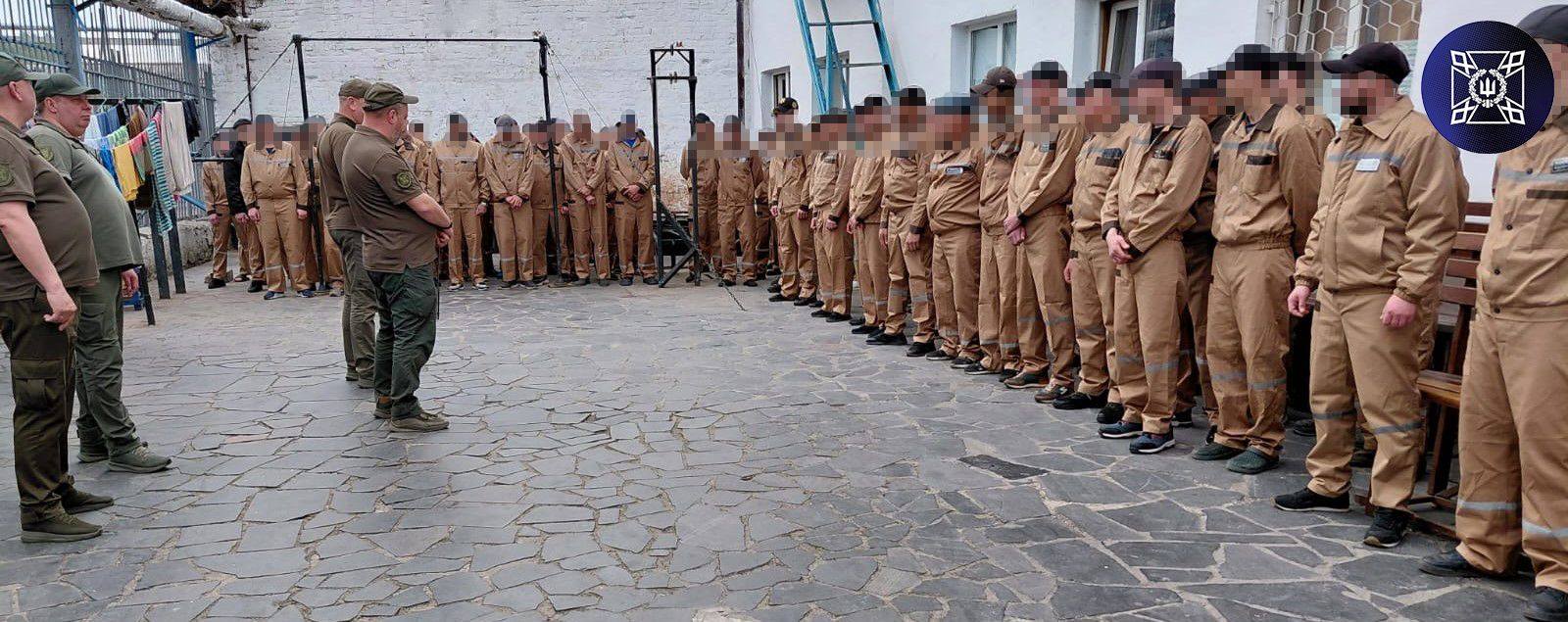
Prisoners who have had new sentences added to their existing ones “for wilful disobedience of the prison authorities” complain that prison staff have fabricated incidents in order to “pile on” additional years to their sentences.
Operatives and trash
Last August, the Arbuzinsky District Court in the Mykolaiv region heard the case of an inmate at South Ukrainian Correctional Colony No. 83. Vitaliy’s refusal to clean the exercise yard at the temporary detention centre would have been just one of dozens of similar cases in other colonies – were it not for one detail. The prisoner told the judge that, immediately upon arrival at the prison, he had spoken to the head of the wing. The latter told the new arrival in no uncertain terms that he would take every possible measure to ensure that Vitaliy’s sentence would be extended. The main phase of this plan was set in motion at Prison No. 83 on 3 March 2025. Vitaliy, who had already been placed in disciplinary isolation, was taken out into the exercise yard for a walk that day. He didn’t have any cigarettes, so he didn’t smoke. He walked alone, without any other prisoners. But for some reason, five prison officers turned up at once to observe the proceedings. After his walk, he was taken back to his cell, whilst the five officers remained in the courtyard. Fifteen minutes later, a crowd of prison staff were already standing outside his cell; pointing a video camera at him, they demanded that he return and sweep the exercise yard. Vitaliy was told that he had left cigarette packets lying around there. Vitaliy refused to comply with this provocation.
The judge heard the application – and handed down a new sentence: 1.5 years. The case is currently being heard on appeal. However, given that over the past five-plus years, we have counted just two out of 416 instances where such sentences have been overturned by the courts of appeal, the odds are certainly not in Vitalii’s favour.
To be the ‘activist’ – or to have a new sentence
Stirring up conflict between prisoners who ‘don’t get on’ with the prison management and the so-called ‘activists’ who actively cooperate with the administration is a typical tactic used by prison ‘bosses’.
Serhiy encountered this very situation at Synelnykivsk Correctional Colony No. 94.
He refused to be transferred to another wing of the prison following this decision by the prison administration. Serhiy assured the judge that the prison staff had deliberately arranged this transfer, knowing about his conflict with another prisoner who was held in that wing. He also told the judge that he had refused to live in that wing because he did not want to commit any further offences. The inmates there were involved in fraudulent activities, and if he had refused, there would have been serious consequences for him.
Serhiy’s case was heard in court, and thanks to the efforts of the Sinelnikivka prison administration, two years were added to his sentence.
We have identified the leading prisons responsible for initiating the imposition of additional sentences on prisoners under Article 391. We analysed data from the Unified State Register of Court Decisions from 2021 to April 2026.
First place, by a considerable margin, is held by Kryvyi Rih Prison No. 80. The administration of this zone ‘arranged’ 59 new additional sentences for its prisoners.
Next in the fight against ‘malicious disobedience to the administration’ is Odesa Prison No. 14, with 22 sentences.
Third place goes to Pervomaisk Prison No. 117, with 19 sentences.
The following places were shared by Drohobych Prison No. 40, Kolomyia Prison No. 41 and Dykany Prison No. 12 – each with 18 additional sentences imposed.
Other prisons that are effectively churning out additional years behind bars include Romny Prison No. 56, Politska Prison No. 76 (17 sentences each), Raikivska Prison No. 73, Sumy Prison No. 116, P’yatykhatska Prison No. 122 and Solonyanska Prison No. 21 (13 each).
If we see these figures by region, the prisons in Dnipropetrovsk Oblast – with 94 sentences – and Kharkiv Oblast – with 67 sentences – lead the way as the harshest regions in terms of imposing additional prison terms.
Refusing to clean the warden’s office?
Another scheme was ‘organised’ against yet another prisoner at Colony No. 94. In court, Vyacheslav insisted that he had been forced to clean the office of the ward supervisor. He naturally refused to carry out such sweeping and cleaning, as this was not a communal area and they had no right to make him clean it under the pretext of ‘improving the grounds’. It was precisely this refusal to clean that the prison administration had most likely counted on. Vyacheslav was provoked into malicious disobedience.
By the time the case reached its final hearing in court, Vyacheslav had served his sentence and was at liberty. However, at the end of September 2023, the Synelnykiv City and District Court decided that another two years behind bars would “do him no harm”. And thanks to the efforts of the Synelnykiv prison, the man was sent back to prison – to serve a new sentence.
Whether he has four months, a few days, or even more than a year left to serve before his release – this does not prevent him from receiving a new sentence under Article 391, organised through the efforts of the prison’s ‘princes’. And sometimes, no sooner has a person been released than they are signed up for a new sentence.
Stanislav, from Pervomaisk Correctional Colony No. 117, managed to spend just 13 days at liberty before his court sentence and a new term for insubordination in that facility.
Report on the number of prisoners
Serhiy has already had new terms imposed on him under Article 391 three times. One of them was in January 2025. Oleksiyivka Correctional Colony No. 25 was behind this. They ‘arranged’ a typical case of insubordination for him – including for refusing, whilst on duty in the disciplinary isolator, to report the number of prisoners in the cell.
In this сase, such a demand by the staff of the Oleksiyivka zone can be interpreted as a provocation. That is precisely how Serhiy perceived it. After all, for all four consecutive days when he was filmed, he was alone in the cell. So the number of inmates was obvious to the staff of Colony No. 25.
They also added a refusal to clean – as a result, thanks to the prison’s efforts, Serhiy received a further two years behind bars.
By the way, at the end of 2025, Serhiy’s sentence was extended once again. And once again under Article 391. If the prison administration continues to treat this prisoner so harshly, the day he is released will be pushed back year after year.
Similarly, Rodion was accused of no reporting on the number of prisoners in the aforementioned 83rd South Ukrainian Colony. He was alone in his cell as well. But the fact that he ‘reported’ that there was only one prisoner in the cell was absolutely essential to the prison administration. He refused and the result was malicious disobedience to the administration’s demands. Quite simply, a crime that undermines the very existence and functioning of the entire prison.
They added to his charges the fact that he had been wearing his own clothes, refusing to wear the prison uniform. The result: two years more .
Kidney disease is no obstacle
But Korosten Correctional Colony No. 71 displayed particular cynicism. Here, they decided to teach a seriously ill prisonera a lesson and ‘organized’ disobedience by him.
Serhiy confirmed in court that he sometimes refused to work because he suffers from kidney disease, which caused him pain.
A prison doctor was summoned to the hearing. The doctor confirmed that, whilst serving his sentence at the colony, Serhiy had been under medical supervision and had periodically asked medical assistance from the medical unit.
XI.
Refused to pay protection money, refused to inform on others, and filed complaints with the prosecutor. Who gets their sentences extended in prisons?
A Belarusian-born inmate repeatedly complained to the prosecutor about the actions of the staff at the Zhytomyr penal colony. Yurii claimed that he had made these complaints orally because the staff of Penal Colony No. 4 refused to provide him with a pen and paper to submit written complaints. According to him, it was precisely because of these complaints that the prison administration developed a personal animosity toward him.
Yurii maintained this version of events before the Bohun District Court of Zhytomyr. Following a petition filed by Penal Colony No. 4, he was facing an additional prison sentence for willful disobedience of the prison administration. Yurii pleaded not guilty.
They handcuffed him and struck him with a baton
"They put handcuffs on me, forced me to do squats, and beat me with a baton," he told the judge.
Yurii insisted that he was unable to perform cleaning duties because of his medical condition. Poor health, spinal and stomach problems, and a flare-up of a peptic ulcer prevented him from carrying out maintenance and landscaping work within the prison grounds.
He regularly sought medical assistance from the colony's physician and took prescribed medication.
Yurii was examined by a medical commission, which decided that he should be hospitalized. He was subsequently transferred to the hospital at Shepetivka Penal Colony No. 98, where he was admitted to the therapeutic ward. Doctors imposed restrictions on his physical activity, determined that heavy physical labor was contraindicated, and prescribed a special diet.
According to an extract from his medical records, Yurii was diagnosed with the after-effects of a previous illness and kyphotic deformity of the thoracic spine.
Nevertheless, the court viewed Yurii's arguments critically, concluding that they were an attempt to evade criminal liability.
The judge justified this decision by stating that the medical records examined during the trial showed that the inmate suffered from several chronic illnesses which exempted him only from heavy physical labor.
According to the court, cleaning duties did not affect his health or aggravate his medical condition.
The judge found no evidence to support Yurii's claims that the prison staff had acted with prejudice against him.
Yurii, who had only 14 days remaining to serve of his original five-year sentence, was sentenced to an additional 18 months' imprisonment for willful disobedience of the prison administration.

Exposed unlawful activities
As we can see, prison administrations pay particular attention to inmates who file complaints or expose unlawful conduct by prison staff. Such prisoners may continue to face retaliation even after they have been released.
That is what happened to Denys, formerly held at Pervomaisk Penal Colony No. 117, who received an additional one-year prison sentence for willful disobedience.
In court, he stated that the administration of Pervomaisk Penal Colony No. 117 sought to punish him for exposing the unlawful activities of the staff at Berdiansk Correctional Colony No. 77, where he had previously served his sentence.
Denys also repeatedly told the court that he had not violated the prison regime. He refused to clean his cell only while prison staff were recording him on video. Once the recording stopped, however, he expressed his willingness to comply with the prison officer's instructions and proceeded to clean the cell.
By the time the court delivered its verdict, Denys had been free for only four and a half months.
Will you inform on other inmates?
Oleksandr, formerly held at Kryvyi Rih Penal Colony No. 80, told the court that prison staff had pressured him to inform on other prisoners. He refused, and, according to his testimony, this resulted in biased treatment against him. He denied committing the offense of willful disobedience, maintaining that the entire case had been fabricated as a provocation against him.
The court, however, did not take these claims into account when delivering its judgment.
One more year behind bars. Another prison sentence. And a return to prison. By the time the verdict was pronounced, Oleksandr had already completed his previous sentence and had been released.
Extortion by Prison Officials
Volodymyr, an inmate at Boryspil Correctional Colony No. 119, told the court that the deputy head of the institution had demanded $1,000 from him. Volodymyr refused to pay. According to his testimony, this was the reason why prison staff developed a biased attitude toward him. He categorically denied the charge of willful disobedience of the lawful orders of the prison administration, arguing that the accusations were fabricated and that the evidence had been falsified by colony staff.
At the request of the defense, the court heard testimony from a defense witness who had been imprisoned at Boryspil Correctional Colony No. 119 at the same time as Volodymyr.
The witness testified that shortly after his arrival at the colony, prison staff began extorting money from him. He identified the prison governor himself as one of those involved in the extortion.
According to the witness, the money was demanded in exchange for avoiding various problems with the prison administration during the course of his sentence.
The witness also testified that he had heard similar stories from other inmates, who said they had also been forced to pay money in order to serve their sentences without interference from the prison administration.
Volodymyr maintained before the court that he had refused to perform outdoor cleaning duties because he was ill and physically unable to carry out such work. He suffered from serious health problems and required hospitalization, but prison staff ignored his requests for medical assistance. He also disputed the findings of the medical assistant who had examined him, arguing that the examination had been superficial and did not accurately reflect his actual medical condition.
Each time he appeared before the prison disciplinary commission, Volodymyr requested legal assistance and asked for a lawyer to be appointed. However, legal representation was never provided. He stated that he had never signed any waiver of his right to counsel.
Volodymyr maintained that the case against him had been fabricated because of the hostile relationship between him and the prison staff.
The date of October 24, 2022 will be remembered as a landmark date for the Ukrainian human rights community. On that day, Judge Serhii Vozniuk of the Boryspil City District Court of Kyiv Region delivered the only acquittal by a court of first instance under Article 391 of the Criminal Code during the previous six years.
The judge ruled that the vast majority of the prison documents on which the prosecution had relied were inadmissible as evidence. The same conclusion was reached with respect to the video recordings.
The court found that the prosecution's claim that the prisoner had categorically refused to comply with a lawful order of the prison administration was based solely on assumptions, which are inadmissible as a basis for a criminal conviction.
The judge also explained that the prosecution under Article 391 of the Criminal Code had relied on the same facts—namely, identical violations of prison regulations—for which Volodymyr had already been subjected to disciplinary sanctions.
In the court's view, imposing criminal liability on a person serving a prison sentence on the basis of a series of substantially identical disciplinary violations, each of which had already resulted in disciplinary punishment, violated the principle of *non bis in idem* ("no one shall be punished twice for the same offence"), as guaranteed by Article 4(1) of Protocol No. 7 to the European Convention on Human Rights.
30.05.2026
Taras Zozulinskyy
The material was prepared within the framework of the project “Promoting the Protection of Human Rights in Ukraine through Human Rights Education and Public Engagement”, funded by the European Union within the framework of the implementation of a sub-grant provided by the Center for Civil Liberties. Its content is the responsibility of the Bureau of Investigative Journalism "Detectives" and does not necessarily reflect the views of the Center for Civil Liberties and the European Union.